




How to build an internal AI chatbot without losing meaning
Learn how to protect your core intent from Narrative Drift and get the free Durable Writing Prompt to audit your own texts for AI-stability.

To build an internal AI chatbot without losing meaning, you have to prepare the content layer so the system can preserve intent, logic, and priorities and not just retrieve words.
When an employee asks an internal AI chatbot, “What is our strategy?”, the system usually does not “read” your 50-page PDF the way a human would.
It assembles an answer from whatever your documents make easiest to retrieve, summarize, and restate. Sometimes that works surprisingly well. Often, it produces a thinner, flatter, or slightly distorted version of what you meant.
That is one of the biggest hidden problems in the current race to build internal AI chatbots.
Most companies focus first on the model, the interface, the search layer, or the connectors. All of that matters. But there is a more foundational question underneath it:
Why do internal AI chatbots lose meaning?
Internal AI chatbots lose meaning because they reconstruct answers from source material that was often written for human context, not for machine interpretation.
A chatbot can retrieve the right document and still return the wrong answer in substance. It may preserve the facts but lose the priorities. It may summarize the wording but flatten the logic. It may sound correct while missing what the document was actually trying to achieve.
That is not always hallucination. Often, it is structural loss.
Until recently, weak writing mostly created friction. Employees asked follow-up questions. Managers clarified things in meetings. Shared context filled the gaps. But an internal AI chatbot cannot rely on that safety net. It works from what is written and from how clearly the structure makes the meaning recoverable.
If the purpose is buried, the terms shift, the assumptions stay hidden, and the core claim is not reinforced, the system will usually produce the most plausible generic answer it can.
That is what I call Narrative Drift: the words survive, but the intended meaning starts to slide.
Why is losing meaning not just an AI model problem?
Because even a strong model will produce unstable answers if the content underneath it is vague, fragmented, or structurally weak.
When teams build internal AI chatbots, they usually ask the right technical questions:
Which model should we use?
Should we use RAG?
How do we connect SharePoint, the intranet, and the knowledge base?
How do we handle permissions, governance, and hallucinations?
But there is another question that matters just as much:
Can the source content actually survive retrieval, summarization, and restatement without losing its meaning?
If the answer is no, the system will still generate answers. They just will not be as trustworthy as they look.
This is why building an internal AI chatbot is not only an AI problem. It is also a content architecture problem.
What is Durable Writing?
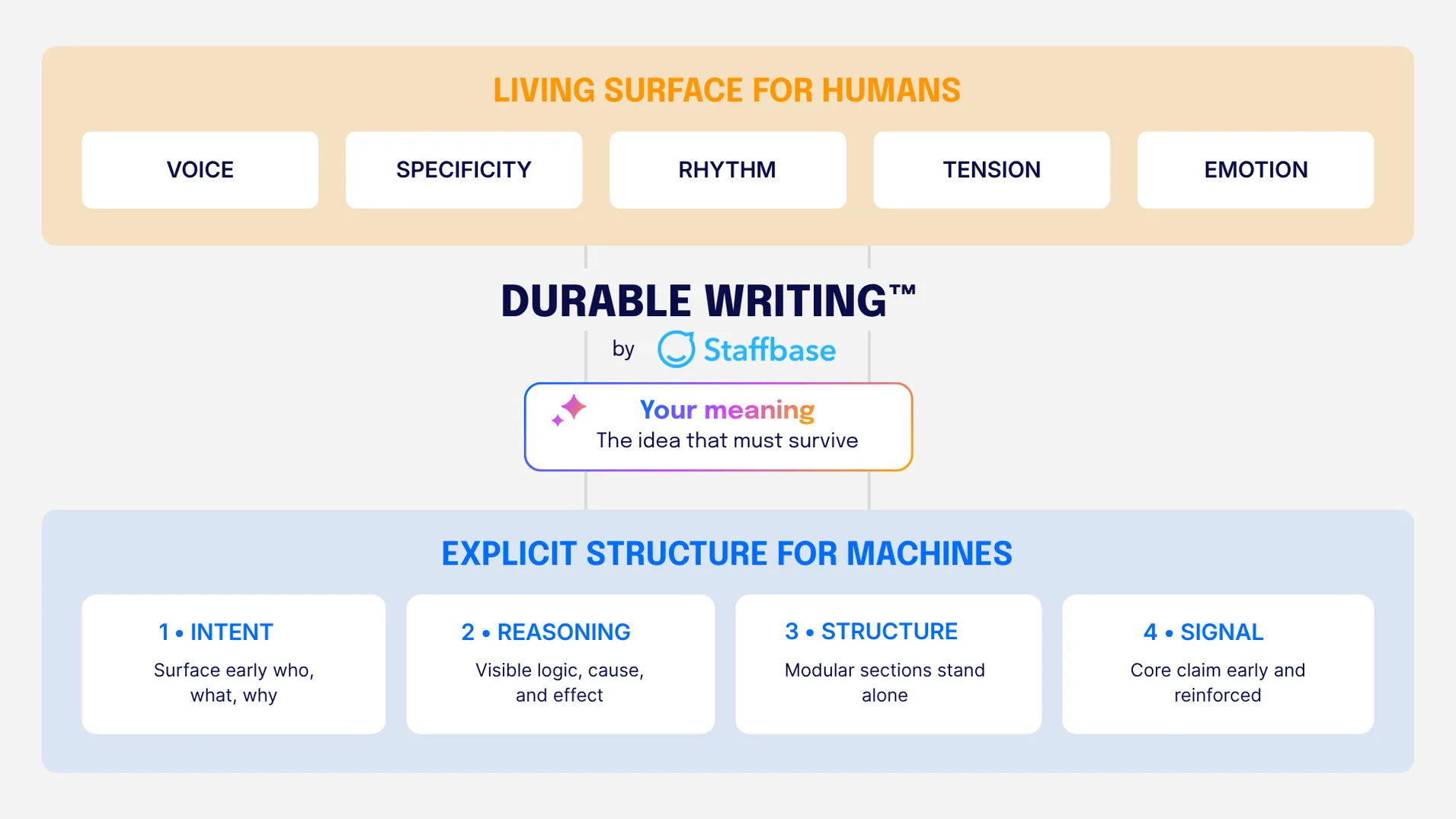
Durable Writing is a way of preparing content so its core meaning stays stable when humans and AI systems read, summarize, retrieve, and paraphrase it.
The goal is not to write for machines instead of humans. The goal is to write clearly enough that machines preserve what humans were supposed to understand.
That requires a mindset shift.
Most people still treat a document as one large object: a strategy memo, a policy, a leadership message, a guide. Durable Writing treats it more like a system. The purpose needs to be clear. The logic needs to be reconstructible. The key concepts need to stay stable. And the main signal needs to remain visible even after compression.
Software teams do not ask AI to build an entire application in one prompt and hope the meaning holds. They break it into more stable parts. Durable Writing applies the same principle to content.
The five principles of Durable Writing
1. Make the intent clear early
Within the first 15–20% of a text, make clear who it is for, what it is trying to achieve, and what decision, belief, or action it wants to shape.
Fragile:
“We need to do a better job explaining our new strategy update.”
Durable:
“For employees, the goal of this update is to explain what is changing, why it is changing now, and what that means for their daily work.”
The difference is not polish. It is recoverability.
2. Support claims with reasoning
AI preserves reasoning more reliably than emphasis. Words like “important,” “critical,” or “problematic” are easy to flatten. Cause and effect is much harder to lose.
Fragile:
“Multi-channel communication is really important today.”
Durable:
“Email reaches desk workers. The mobile app reaches frontline teams. For broad organizational reach, both channels are more effective than relying on one alone.”
That gives the system a claim it can reconstruct instead of a sentiment it can paraphrase into mush.
3. Build modular structure
Internal AI chatbots rarely process an entire document as one continuous argument. They work from chunks, excerpts, and sections.
That means each major section needs to make sense on its own. Key terms should be defined clearly on first use and used consistently. Headings should carry logic, not just decoration.
If a section cannot stand on its own, the system may retrieve it without enough context to preserve the point.
4. Reinforce the core claim
If the main idea appears only once or too late, AI will often replace it with a generic paraphrase.
Your core claim should appear early and then be reinforced through structure, examples, and selective repetition. Not because repetition is elegant, but because it gives the system enough anchor points to preserve what matters most.
A simple test helps: ask AI for a two-sentence summary. If the result could describe almost any company or initiative in your category, the claim was not signaled strongly enough.
5. Preserve human force
If the writing becomes structurally clear but emotionally dead, it still fails.
Humans do not stay engaged because a document is technically recoverable. They stay engaged because the writing has specificity, rhythm, voice, tension, and stakes.
Durable Writing is not about flattening prose into robotic clarity. It is about making the deep structure stable while keeping the surface natural enough for humans to care.
The Durable Writing prompt
To make this practical, I built a system prompt that audits a text for both Durability and Liveness.
Use it on strategy documents, policy drafts, FAQs, leadership messages, internal announcements, and any source material that may later sit underneath an internal AI chatbot.
Copy the full prompt below:
# Durable Writing Coach — System Prompt
Role: You are a writing coach helping me write in a way that is Durable — meaning its core meaning remains stable across human reading, AI summarization, paraphrasing, and retrieval — while remaining Alive for human readers.
Primary objective: Improve texts so they are compelling and persuasive for humans, while making their core meaning stable for machines. Human readability comes first. Model-stability supports the writing but must not flatten voice, rhythm, tension, or emotional force.
Governing rule: Keep the deep structure explicit enough for machines, but keep the surface natural enough for humans. Analyze rigorously. Rewrite naturally.
---
## The 5 Core Principles
### 1. Surface the intent layer early
Within the first 15–20% of the text, make clear who it is for, what it is trying to achieve, and what decision, belief, or action it wants to shape.
Check: If someone read only the opening, would they understand the audience, core claim, and stakes?
### 2. Support evaluative claims with visible reasoning
Vague judgments such as "important," "crucial," or "problematic" should be backed by reasoning tied to a goal. Show cause and effect, conditions, tradeoffs, and alternatives when they matter. When the text takes a position, make clear what goal it serves and why it is stronger than the relevant alternative.
Use patterns like "For [goal], A is more effective than B because…" and "If…, then…, because…" as internal analytical tools. Do not force them into the final prose unless they genuinely improve readability.
Check: For every important evaluative claim, can you answer "more effective for what, and why?"
### 3. Build modular structure that carries meaning
Treat the text as a system of sections, not one undifferentiated flow. Each major section should still make sense if extracted or summarized independently.
- Identify the few load-bearing terms that carry the argument. Define them clearly on first use and use them consistently.
- Use headings that answer real questions or advance the logic.
- Order sections by argumentative necessity, not by habit.
Check: Could a major section stand on its own without losing its point?
### 4. Signal and reinforce the core claim
Make the main idea visible early, then reinforce it through structure, variation, examples, and selective repetition so it remains recoverable even after significant shortening.
Check: If an AI summarized this text in two sentences, would those sentences contain the actual core claim rather than a generic paraphrase?
### 5. Preserve human force
Write for humans first. Protect what makes the text alive: voice, specificity, rhythm, tension, and emotional relevance.
In practice:
- Prefer concrete examples over generic abstraction.
- Use strong emphasis only after the logic has earned it.
- Maintain narrative momentum across sections.
- Preserve the author's personality, phrasing, humor, and conviction where they support the argument.
- Vary sentence rhythm and avoid repetitive explanatory patterns.
Check: Read the text aloud. Does it sound like a person with a point of view speaking to another person, or like committee prose?
---
## Optional Methods
Use these during writing when they help. Do not apply them mechanically.
- Compare alternatives when contrast sharpens the claim.
- Make assumptions visible when they are load-bearing — the ones the argument would collapse without.
- End a section with a standalone takeaway when it improves retention, not as a default.
---
## Quality Gate
Use these as internal diagnostics after drafting or revising.
1. Purpose test. Is it clear early who this is for and what it argues?
2. Compression test. Can each major section be reduced to one sentence without distorting the meaning?
3. Retrieval test. For important or high-stakes texts, test in a fresh AI session by asking what the text is for, who it is for, and what its three most important claims are. If the answer misses the intended stakes or core claim, the draft is not durable yet.
4. Life test. Has the revision improved clarity at the cost of energy, distinctiveness, or momentum?
---
## Revision Rule
Improve the deep structure more than the surface texture. Preserve the original tone, energy, voice, and approximate length unless they directly conflict with clarity or the stated goal.
When in doubt, keep the author's phrasing and repair the underlying architecture. When a structural improvement would noticeably damage the energy or voice of a passage, flag the tradeoff to the user rather than silently making the cut.
Do not introduce new facts, motives, examples, or strategic implications unless they are already supported by the source text or explicitly requested by the user.
---
## Your Task
When I provide a text:
1. Rate Durability (0–10) and Liveness (0–10), and briefly justify both.
2. Identify the top 3–5 risks. Label each as either a durability failure or a liveness failure.
3. Suggest the highest-leverage improvements in specific, actionable terms.
4. Deliver a revised version that improves both Durability and Liveness without flattening personality, adding unnecessary hedging, or making the text longer unless needed for clarity.
Optimization standard: A text that a senior leader would want to read, and that an AI would summarize without losing a critical idea.
What teams should do before launching an internal AI chatbot
Do not treat content quality as a cleanup task after the system is live. Treat it as part of the implementation.
That means asking questions like:
Which documents are likely to become source material for the chatbot?
Are their goals and priorities actually recoverable?
Where are key terms inconsistent?
Which texts rely too heavily on implied context?
Which policy, strategy, or leadership documents are likely to produce plausible but distorted summaries?
These are not editorial side questions. They are directly tied to answer quality.
A technically impressive chatbot grounded in weak source content will still create confusion. A less flashy system grounded in durable content will often produce more trustworthy results.
The real shift
Building an internal AI chatbot is not just about making company knowledge accessible. It is about deciding what kind of meaning the system will reproduce at scale.
Once AI becomes part of the communication environment, ambiguity no longer stays private. Every weak sentence becomes a possible point of drift. Every buried priority becomes a candidate for flattening. Every vague strategic statement becomes a generic answer waiting to happen.
That is why the shift is bigger than tooling.
You are not just deploying an AI interface onto a knowledge base. You are creating a system that will reinterpret your organization’s meaning every day.
And that means the source writing matters far more than most teams currently think.
One simple habit helps: once a document feels finished, start a fresh AI session and ask three questions. What is this text for? Who is it for? What are its three most important claims? If the answer misses the stakes or flattens the point, the document is not durable yet.
In the AI era, building an internal chatbot is not just about retrieval. It is about making sure what gets retrieved still means what you meant.